Post-Purchase Nurture Sequences: The Technical Setup in HubSpot vs. Marketo
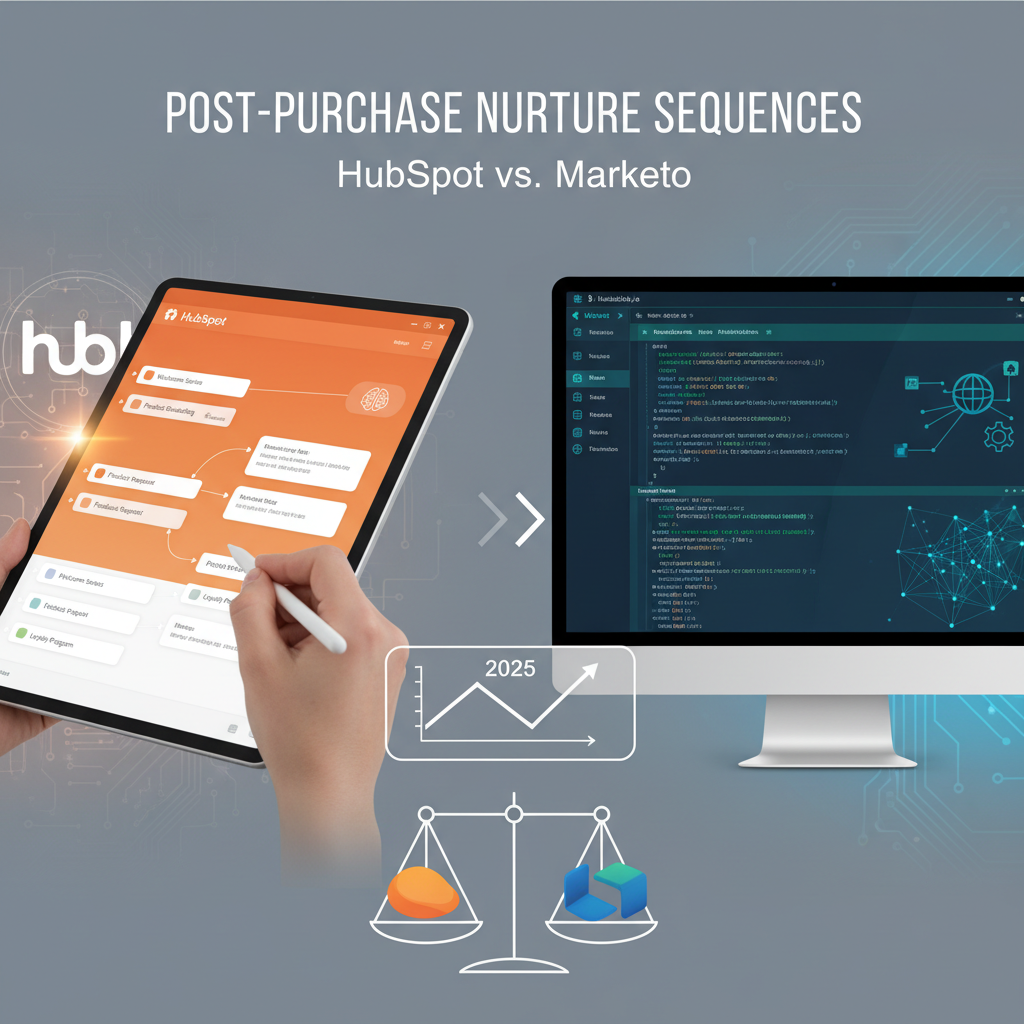
In the increasingly competitive landscape of 2025, the sale is just the beginning of your customer relationship journey. Post-purchase nurture sequences have evolved from optional follow-ups to mission-critical revenue drivers that determine whether a one-time buyer becomes a lifetime advocate. As marketing automation platforms continue to advance, choosing between HubSpot and Marketo for your post-purchase nurture sequences requires understanding not just their features, but their technical architectures, implementation complexities, and real-world performance. This comprehensive guide dissects the technical setup of post-purchase nurture sequences in both platforms, revealing which solution aligns with your business objectives, technical capabilities, and growth trajectory.
Key Takeaways
- HubSpot offers superior user-friendliness with visual workflow builders that reduce implementation time by 40-60% compared to Marketo's more technical approach
- Marketo excels in enterprise complexity with advanced tokenization, nested logic, and multi-touch attribution that supports sophisticated customer journeys
- Integration architecture differs significantly - HubSpot's native CRM integration provides seamless data flow while Marketo requires more deliberate API configuration
- Cost structures impact ROI calculations - HubSpot's bundled pricing simplifies budgeting while Marketo's modular approach offers flexibility for large-scale operations
- AI capabilities in 2025 have transformed both platforms, with HubSpot focusing on accessibility and Marketo emphasizing predictive analytics for enterprise users
Table of Contents
- Understanding Post-Purchase Nurture Sequences in 2025
- HubSpot Technical Architecture for Post-Purchase Sequences
- Marketo Technical Architecture for Post-Purchase Sequences
- Workflow Configuration Comparison
- Data Synchronization and Triggers
- Personalization and Segmentation Capabilities
- Reporting and Optimization Features
- Implementation Timeline and Complexity
- Frequently Asked Questions (FAQ)
- Sources & References
Understanding Post-Purchase Nurture Sequences in 2025
Post-purchase nurture sequences have evolved dramatically in 2025, moving beyond simple "thank you" emails to sophisticated, multi-channel journeys that drive retention, upsells, and advocacy. These automated sequences bridge the critical gap between acquisition and customer retention, transforming one-time buyers into loyal brand advocates.
Modern post-purchase sequences typically encompass order confirmation, shipping updates, product education, usage optimization, review requests, cross-sell opportunities, and loyalty program engagement. The technical infrastructure supporting these sequences must handle real-time data synchronization, conditional logic based on customer behavior, and seamless integration with ecommerce platforms, CRM systems, and customer data platforms.
The distinction between HubSpot and Marketo in this domain centers on their philosophical approaches: HubSpot prioritizes accessibility and integrated functionality, while Marketo emphasizes power, flexibility, and enterprise-grade customization. Understanding these fundamental differences determines which platform will serve your post-purchase strategy most effectively.
HubSpot Technical Architecture for Post-Purchase Sequences
HubSpot's technical architecture for post-purchase nurture sequences is built around its native CRM, creating a unified data environment that simplifies implementation. The platform's workflow engine operates within a visual drag-and-drop interface that non-technical marketers can navigate while still offering advanced capabilities for technical users.
Workflow Builder and Automation Engine
HubSpot's workflow builder utilizes a node-based system where each action, delay, or conditional branch appears as a visual element. Post-purchase sequences typically begin with an enrollment trigger—most commonly "Deal Stage is Won" or a custom event from your ecommerce integration. The platform supports time-based delays, property-based branching, and action-triggered re-enrollment, all configured through intuitive interfaces.
In 2025, HubSpot has enhanced its workflow capabilities with AI-powered recommendations that suggest optimal send times, content variations, and branching logic based on historical performance data. This reduces the technical burden on marketers while improving sequence effectiveness.
Integration Ecosystem
HubSpot's post-purchase sequences benefit from native integrations with major ecommerce platforms including Shopify, WooCommerce, and BigCommerce. These integrations sync purchase data, product information, and customer attributes automatically, enabling sophisticated segmentation without manual data mapping. The platform's Operations Hub provides additional data synchronization capabilities for complex enterprise environments.
API connectivity is straightforward for custom integrations, with webhook support for real-time event triggering. This proves essential when post-purchase sequences need to respond to external events like shipping confirmations, support ticket creation, or subscription modifications.
Marketo Technical Architecture for Post-Purchase Sequences
Marketo's technical architecture approaches post-purchase nurture from an enterprise perspective, offering granular control over every aspect of the customer journey. The platform separates data management (lead database), campaign logic (smart campaigns), and content delivery (email programs), requiring more technical expertise but providing greater flexibility.
Smart Campaigns and Engagement Programs
Marketo's smart campaigns form the backbone of post-purchase sequences, utilizing a three-part structure: Smart List (defines who qualifies), Flow (defines what happens), and Schedule (defines when it happens). This separation allows for complex logic chains and reusable components that enterprise organizations value.
Engagement Programs represent Marketo's specialized nurture engine, supporting stream-based content delivery with automatic progression rules. For post-purchase sequences, Engagement Programs enable sophisticated cadence management where customers automatically progress through educational content, upgrade prompts, and loyalty touchpoints based on their engagement patterns.
Revenue Cycle Modeler
Marketo's Revenue Cycle Modeler provides stage-based tracking that extends beyond the initial purchase, mapping the complete customer lifecycle. This technical framework enables post-purchase sequences to adapt based on customer lifecycle stage, automatically adjusting messaging and offers as customers progress from new buyer to repeat customer to advocate.
The integration with Adobe Experience Cloud (following Adobe's acquisition) has strengthened Marketo's data capabilities in 2025, enabling real-time behavioral data to inform post-purchase sequence logic. This tight integration supports hyper-personalization at scale, though it requires technical expertise to implement effectively.
Workflow Configuration Comparison
The practical differences between HubSpot and Marketo become apparent when configuring actual post-purchase sequences. Consider a common scenario: sending a product education sequence that adapts based on product category and customer engagement.
HubSpot Configuration Approach
In HubSpot, you create a single workflow with enrollment criteria based on "Recent conversion = Purchase" and a property filter for product category. The workflow visually branches based on product type, with each branch containing its educational content series. Re-enrollment is configured at the workflow level, and personalization tokens pull customer and product data directly from connected properties.
The entire setup typically requires 2-4 hours for a moderately complex sequence, with testing conducted through HubSpot's built-in preview and test contact features. Changes can be made to active workflows without disrupting enrolled contacts, and version history tracking maintains an audit trail.
Marketo Configuration Approach
Marketo's approach involves creating multiple interdependent smart campaigns or an Engagement Program with conditional streams. The initial smart campaign identifies qualified purchasers and updates their data values (product category, purchase date, customer status). Subsequent campaigns check these data values to determine content delivery paths.
Tokenization at multiple levels (program, folder, and system) enables sophisticated personalization, but requires careful planning of your naming conventions and data architecture. The setup time for equivalent functionality typically ranges from 4-8 hours, reflecting the additional configuration complexity. However, this investment enables more granular control and easier scalability for enterprise organizations managing dozens of post-purchase sequences simultaneously.
Data Synchronization and Triggers
Effective post-purchase sequences depend on accurate, real-time data synchronization between your ecommerce platform, CRM, and marketing automation system. The technical differences between HubSpot and Marketo significantly impact implementation complexity and reliability.
HubSpot Data Flow
HubSpot's native CRM integration eliminates a common friction point—deal data, contact properties, and custom objects sync automatically without additional configuration. When a deal moves to "Closed Won," this triggers enrollment in post-purchase workflows immediately. Custom ecommerce integrations built on HubSpot's API follow a similar pattern, with webhook support enabling real-time event processing.
The platform's Operations Hub provides data quality tools including deduplication, formatting standardization, and calculated properties that clean data before it enters post-purchase sequences. This reduces deliverability issues and personalization errors that plague many automated systems.
Marketo Data Flow
Marketo requires deliberate integration architecture, typically connecting to Salesforce or another CRM through native connectors, then receiving ecommerce data through API calls or third-party integration platforms like Jitterbit or Boomi. This separation allows for sophisticated data transformation and routing but introduces additional failure points.
Smart campaigns monitor for specific data changes (new opportunity with closed-won status, new purchase record, updated product ownership field) to trigger post-purchase sequences. The lag between event occurrence and campaign trigger typically ranges from 5-15 minutes depending on sync frequency, which matters for time-sensitive communications like order confirmations.
Marketo's advantage emerges in complex enterprise environments where data originates from multiple systems—ERP, subscription management, customer success platforms—all feeding into unified customer profiles that inform post-purchase nurture logic.
Personalization and Segmentation Capabilities
The effectiveness of post-purchase nurture sequences depends heavily on personalization and segmentation capabilities. Both platforms offer robust options, but with different approaches and complexity levels.
HubSpot Personalization
HubSpot implements personalization through a token system that pulls data from contact properties, company properties, deal properties, and custom objects. The Smart Content feature enables dynamic email sections that display different content based on contact list membership, lifecycle stage, device type, or custom criteria.
In 2025, HubSpot's AI content assistant helps optimize personalization by suggesting high-performing subject line variations, call-to-action copy, and content blocks based on customer segment. The platform's behavioral event tracking enables sequences to branch based on website activity, email engagement, and content consumption patterns.
Marketo Personalization
Marketo's three-tier token system (system, program, and custom) provides granular control over content personalization. Combined with segmentation at the email send level, this enables sophisticated one-to-one personalization at scale. Velocity scripting (based on Apache Velocity) allows developers to implement complex conditional logic directly within email templates, supporting scenarios like "show product recommendations based on purchase history and browsing behavior."
Dynamic content modules in Marketo emails can display variations based on segment membership, with unlimited segments per module. This technical capability supports advanced strategies like showing different upgrade paths based on product tier, usage volume, and customer lifecycle stage—all within a single email asset.
Reporting and Optimization Features
Measuring and optimizing post-purchase sequence performance requires robust analytics. Both platforms provide reporting capabilities, but with different strengths and technical requirements.
HubSpot Reporting
HubSpot's workflow performance reports provide clear visibility into enrollment, completion rates, and goal achievement. The attribution reporting connects post-purchase sequence interactions to revenue outcomes, showing which touchpoints drive repeat purchases, upsells, and referrals. Custom reports combine workflow metrics with deal data, enabling analysis of customer lifetime value by acquisition source or product category.
The platform's dashboard functionality allows marketers to create real-time monitoring views that track key post-purchase metrics without technical assistance. A/B testing within workflows tests different email variations, delays, or content sequences, with automatic winner selection based on predefined criteria.
Marketo Reporting
Marketo's reporting requires more technical setup but delivers enterprise-grade analytics. Revenue Cycle Analytics connects post-purchase engagement to revenue stages, calculating metrics like velocity through customer lifecycle stages and influence of specific nurture touchpoints on expansion revenue.
Email performance reports provide granular metrics at the program and individual asset level. Success path analysis visualizes the actual paths customers take through multi-touch sequences, identifying unexpected behavior patterns. Integration with Adobe Analytics (in 2025) provides unified customer journey visualization across marketing automation, web analytics, and customer experience data.
Champion/Challenger testing in Marketo enables simultaneous testing of multiple variants with statistical significance calculations, supporting more sophisticated optimization for high-volume sequences.
Implementation Timeline and Complexity
The technical setup time and complexity for post-purchase nurture sequences varies significantly between HubSpot and Marketo, impacting both initial launch and ongoing management.
HubSpot Implementation
A typical post-purchase nurture sequence implementation in HubSpot follows this timeline:
- Week 1: Data architecture review, ecommerce integration configuration, custom property creation
- Week 2: Workflow construction, email template creation, personalization token setup
- Week 3: Testing across customer segments, edge case validation, reporting dashboard configuration
- Week 4: Soft launch with limited audience, monitoring and adjustment
Technical resources required include a marketing operations specialist familiar with HubSpot's interface and basic HTML for email customization. Most organizations can implement effective post-purchase sequences without developer involvement, though complex scenarios benefit from API expertise.
Marketo Implementation
Marketo's implementation typically requires a longer timeline:
- Weeks 1-2: Data architecture design, CRM field mapping, integration configuration and testing
- Weeks 3-4: Program structure creation, smart campaign logic development, token strategy implementation
- Weeks 5-6: Email template development with dynamic content, segmentation refinement
- Weeks 7-8: Comprehensive testing, reporting configuration, documentation
- Week 9: Phased rollout with close monitoring
Technical resources typically include a certified Marketo architect or administrator, plus front-end development resources for advanced email templates. The investment pays dividends in flexibility and control, particularly for organizations managing complex product lines or global operations.
Ongoing management also differs significantly. HubSpot sequences can be modified by marketing team members with appropriate training, while Marketo changes often require specialized expertise to avoid unintended consequences in interdependent campaign logic.
Frequently Asked Questions (FAQ)
Can I migrate post-purchase sequences from Marketo to HubSpot or vice versa?
Yes, but migration is not a simple export/import process. The fundamental differences in platform architecture require rebuilding sequence logic in the new