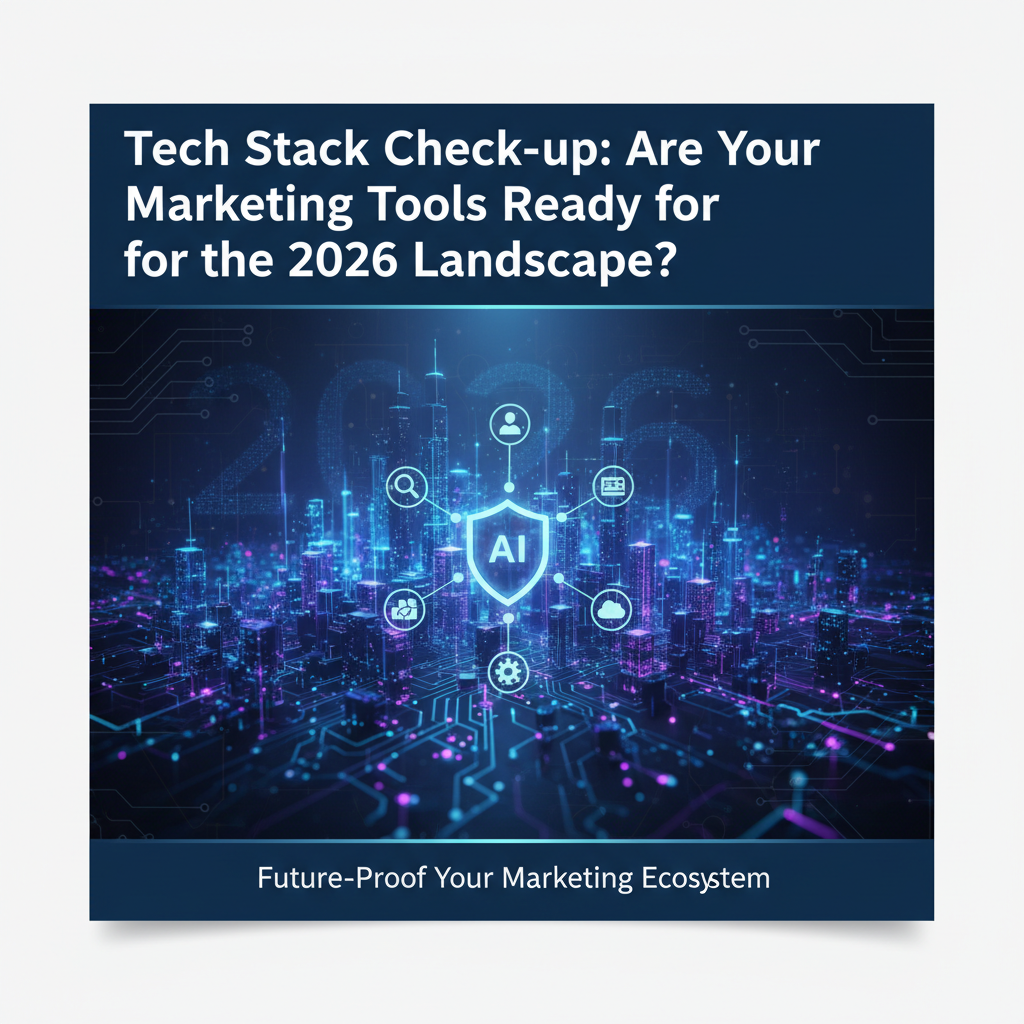
Tech Stack Check-up: Are Your Marketing Tools Ready for the 2026 Landscape?
As we navigate the fast-paced marketing environment of 2025, the technology that powers our strategies is more critical than ever. The rapid evolution of AI, shifting privacy regulations, and rising customer expectations have created a complex landscape where the right tools can mean the difference between leading the pack and falling behind. With 2026 on the horizon, now is the perfect time to perform a comprehensive Tech Stack Check-up: Are Your Marketing Tools Ready for the 2026 Landscape? This isn't just about having the latest software; it's about ensuring your stack is integrated, intelligent, and agile enough to capitalize on the opportunities of tomorrow.
Key Takeaways
- AI is Foundational: In 2025, AI-powered features for personalization, content creation, and analytics are no longer optional extras but essential components of a competitive marketing stack.
- Integration Over Isolation: A collection of powerful but disconnected tools creates data silos. The future is a seamlessly integrated ecosystem where data flows freely to create a unified customer view.
- First-Party Data is Gold: With the deprecation of third-party cookies now a firm reality, your ability to collect, manage, and activate first-party data is paramount for effective targeting and personalization.
- Proactive Audits are Crucial: Regularly auditing your tech stack for redundancies, gaps, and performance issues is key to maximizing ROI and staying ahead of market shifts.
Table of Contents
- The 2025 Marketing Tech Reality: Integration and Intelligence
- Auditing Your Current Stack: A 5-Step Process for 2026 Readiness
- Key Trends Shaping the 2026 Marketing Landscape
- Essential Tools for Your 2026-Ready Stack
- Frequently Asked Questions (FAQ)
- Your Next Steps to a Future-Proof Stack
The 2025 Marketing Tech Reality: Integration and Intelligence
The marketing technology landscape of 2025 is defined by two core themes: deep intelligence and seamless integration. Standalone tools that perform a single function are being replaced by platforms that offer a cohesive suite of services or by "composable" stacks that connect best-in-class tools via robust APIs. We've moved beyond simply automating emails; today's technology must predict customer needs, personalize experiences in real-time, and provide clear, actionable insights from complex data sets. A poorly integrated stack is a primary reason why so many marketing campaigns fail to meet their objectives, creating friction for both your team and your customers.
Auditing Your Current Stack: A 5-Step Process for 2026 Readiness
Before you can build the stack of the future, you must understand the one you have today. A thorough audit will reveal what's working, what's redundant, and where the critical gaps lie.
1. Map Your Customer Journey
Start by mapping every touchpoint a customer has with your brand, from initial awareness to post-purchase loyalty. Identify which tool is used at each stage. This visual representation often highlights inconsistencies in the customer experience and reveals where data handoffs are failing.
2. Identify Redundancies and Gaps
Are you paying for three different tools that all have overlapping social media scheduling features? Is there a critical gap in your ability to analyze customer behavior on your website? Eliminating redundant software saves money, while filling gaps ensures you can execute a complete strategy.
3. Evaluate Tool Integration and Data Flow
Assess how well your tools communicate. Does your CRM data flow seamlessly into your email marketing platform? Can your analytics tool attribute conversions back to specific campaigns? Poor integration leads to data silos and an incomplete picture of your marketing performance.
4. Assess AI and Automation Capabilities
Review each tool's AI features. Does it offer predictive lead scoring, automated content suggestions, or smart segmentation? The future of lead generation and customer engagement relies heavily on this intelligence. If your core platforms lack these capabilities, they may be holding you back.
5. Calculate Total Cost of Ownership (TCO)
Look beyond the monthly subscription fee. Factor in costs for implementation, training, maintenance, and the man-hours required to manage each platform. A cheaper tool that requires significant manual work may have a higher TCO than a more expensive, highly automated platform.
Key Trends Shaping the 2026 Marketing Landscape
To ensure your tech stack is ready for 2026, it must be aligned with the trends that will define the market. Here are the key areas to focus on.
Hyper-Personalization at Scale
Customers now expect brands to understand their individual needs and preferences. By 2026, generic messaging will be completely ignored. Your tech stack must be able to leverage deep data to deliver one-to-one experiences across all channels. This requires powerful CRM Personalization capabilities that can translate data into dynamic content, product recommendations, and tailored offers.
Predictive Analytics and AI-Driven Insights
The next frontier is moving from reactive to predictive marketing. Your 2026 stack should use AI to forecast customer churn, identify high-value leads, and recommend the "next best action" for each customer segment. This proactive approach allows you to address opportunities and challenges before they fully emerge.
Enhanced Privacy and First-Party Data Management
Trust is the new currency. With data privacy regulations becoming more stringent globally, your ability to ethically collect, store, and utilize first-party data is a competitive advantage. Customer Data Platforms (CDPs) will become central to the marketing stack, providing a secure, unified hub for all customer information.
Essential Tools for Your 2026-Ready Stack
While the specific brands may vary, a future-proof marketing stack will be built around these core capabilities:
- Customer Data Platform (CDP): A CDP is the heart of a modern stack, ingesting data from all sources (website, CRM, support tickets) to create a single, persistent customer profile that can be used to power personalization across other tools.
- AI-Powered Content & SEO Platforms: Tools that not only help generate content but also optimize it for both human engagement and AI search algorithms will be indispensable for maintaining visibility.
- Advanced Marketing Automation: Look for platforms that offer sophisticated journey orchestration, allowing you to build dynamic, multi-path campaigns that adapt to customer behavior in real-time. This is crucial for effective lead management from initial inquiry to final sale.
- Business Intelligence (BI) and Visualization Tools: Raw data is useless. Tools like Tableau, Looker, or Power BI are essential for transforming complex datasets into intuitive dashboards that empower your team to make smarter, faster decisions.
Frequently Asked Questions (FAQ)
What is the biggest mistake companies make with their marketing tech stack?
The most common mistake is "shiny object syndrome"—adopting new tools without a clear strategy or integration plan. This leads to a bloated, disconnected stack that creates more work than it saves and results in a fragmented customer experience.
How often should I conduct a tech stack check-up?
A deep audit should be performed annually. However, you should conduct smaller, quarterly reviews to assess tool performance, user adoption, and alignment with your current campaign goals.
Is an all-in-one platform better than best-of-breed tools?
This depends on your team's size and technical expertise. All-in-one platforms (like HubSpot or GoHighLevel) offer simplicity and built-in integration. A best-of-breed or "composable" stack offers more power and flexibility but requires more effort to manage integrations.
How important is AI in a 2026 marketing stack?
It is absolutely critical. By 2026, AI won't be a feature; it will be the underlying engine for personalization, analytics, optimization, and automation. A stack without strong AI capabilities will be at a significant competitive disadvantage.
What is the difference between a CRM and a CDP?
A CRM (Customer Relationship Management) is primarily a system of record for sales and service interactions. A CDP (Customer Data Platform) is designed to ingest data from all sources (including the CRM) to create a comprehensive, unified profile of each customer for marketing purposes.
How can a small business afford a modern tech stack?
Many modern SaaS tools offer scalable pricing tiers, allowing small businesses to start with essential features and upgrade as they grow. The key is to focus on tools that provide the highest ROI and solve your most pressing business challenges first.
Your Next Steps to a Future-Proof Stack
The pace of technological change is only accelerating. The decisions you make about your marketing technology in 2025 will directly impact your ability to compete and grow in 2026 and beyond. By conducting a thorough audit, aligning your tools with future trends, and prioritizing integration and intelligence, you can build a marketing tech stack that serves as a powerful engine for growth. Don't let your technology become an anchor holding you in the past; transform it into the rocket ship that propels you into the future.
Is Your Tech Stack Ready for What's Next?
Don't wait until 2026 to find out your tools are obsolete. Our experts can help you audit your current stack, identify critical gaps, and build a roadmap for a future-proof marketing ecosystem.
Schedule a Free ConsultationSources & References
Gartner Magic Quadrant for B2B Marketing Automation Platforms - Gartner
The Future Of B2B Marketing Is A Tale Of Two Realities - Forrester