Year-End CRM Cleanup: Optimizing Your Data for a Strong Start to 2026
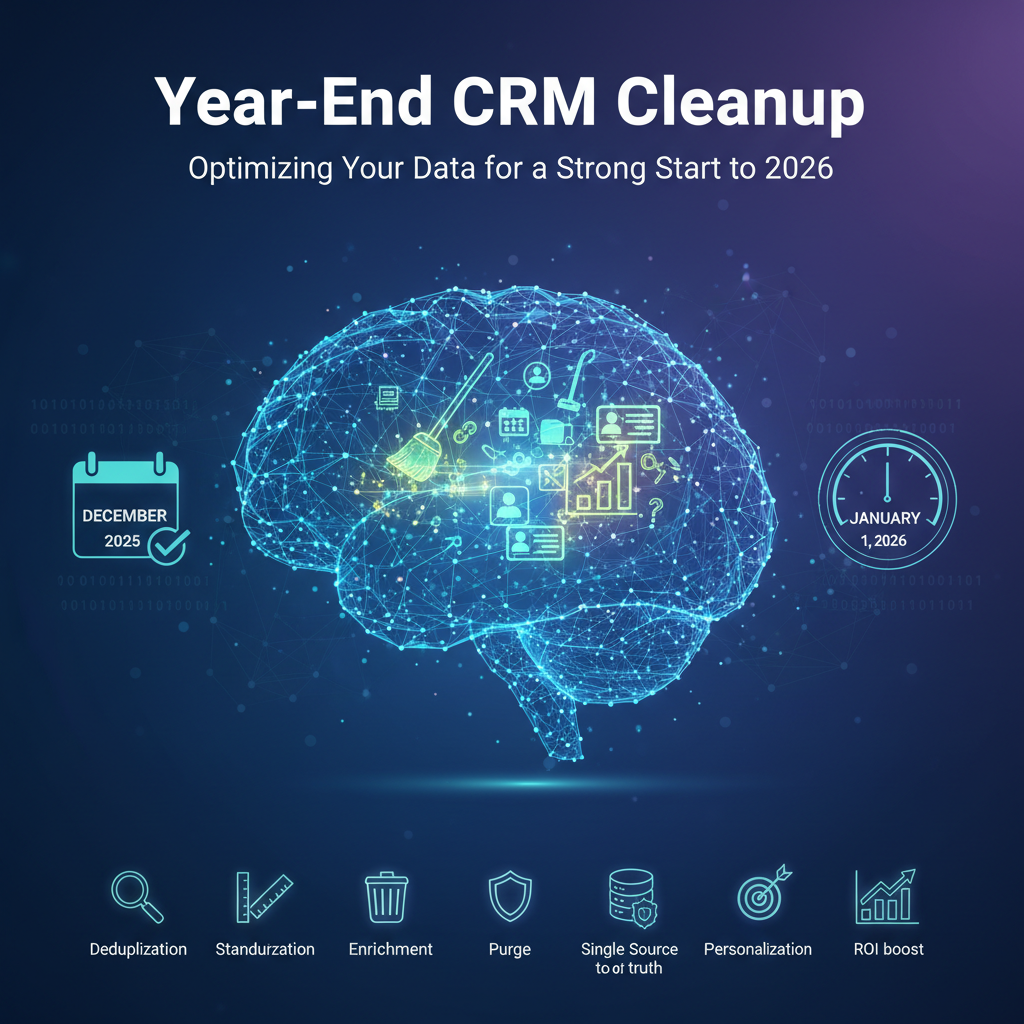
The end-of-year rush is upon us. As your team navigates the final, hectic quarter of 2025, your Customer Relationship Management (CRM) system has likely become a chaotic mix of new holiday leads, outdated contacts, and inconsistent data entries. While it's tempting to push a deep clean to the back burner, the truth is that the quality of your data today directly dictates your success tomorrow. In an era where AI-driven personalization and predictive analytics are no longer futuristic concepts but table stakes, starting 2026 with a cluttered CRM is like trying to run a marathon with weights tied to your ankles. A strategic Year-End CRM Cleanup: Optimizing Your Data for a Strong Start to 2026 is your single most powerful move to ensure a streamlined, profitable, and successful new year.
Key Takeaways
- Data is a Strategic Asset: In 2025, high-quality CRM data is a critical business asset that fuels personalization, AI-driven insights, and accurate forecasting for 2026.
- Proactive Hygiene Prevents Decay: Data naturally decays at a rate of over 20% per year. Regular cleanup prevents this, ensuring your marketing and sales efforts are efficient and effective.
- Standardization is Key: Implementing and enforcing standardized data entry protocols across your team is crucial for long-term data integrity and usability.
- Cleanup Fuels Strategy: A clean CRM provides the reliable data needed to build a powerful 2026 content calendar strategy and make informed business decisions.
Table of Contents
- Why a Year-End Cleanup is Critical in 2025
- Your 7-Step CRM Cleanup Checklist for Q4 2025
- Leveraging Your Clean CRM for a Powerful 2026
- Frequently Asked Questions (FAQ)
Why a Year-End Cleanup is Critical in 2025
Ignoring CRM hygiene isn't just a minor oversight; it's a significant strategic misstep. In 2025, the consequences of poor data quality are more severe than ever. Inaccurate or incomplete data leads to bounced emails, wasted sales calls, and flawed marketing campaigns. More importantly, it cripples the advanced tools you rely on. The sophisticated AI and machine learning algorithms that power predictive lead scoring and hyper-personalization are only as good as the data they are fed. Garbage in, garbage out.
Furthermore, with data privacy regulations constantly evolving, maintaining a clean and accurate database is a matter of compliance and customer trust. A year-end cleanup allows you to verify consent, honor communication preferences, and demonstrate a commitment to responsible data stewardship, setting a foundation of trust for the year ahead.
Your 7-Step CRM Cleanup Checklist for Q4 2025
Tackle your CRM cleanup systematically with this actionable checklist. Dedicate time in Q4 to ensure you hit the ground running on January 1st, 2026.
1. De-duplicate and Merge Records
Duplicate records are a primary source of confusion, leading to multiple salespeople contacting the same lead or skewed analytics. Use your CRM's built-in de-duplication tools or a third-party app to find and merge duplicate contacts, companies, and deals. Establish a primary record and consolidate all notes, activities, and contact information.
2. Standardize and Normalize Data Fields
Inconsistency breeds chaos. Are job titles capitalized? Are states abbreviated or spelled out? Are phone numbers formatted uniformly? Create a data dictionary or style guide for your team and use spreadsheet functions or CRM tools to enforce these standards across your entire database. This makes filtering, segmenting, and reporting far more reliable.
3. Purge Inactive and Obsolete Contacts
A large database isn't necessarily a healthy one. Identify and remove contacts that are unengaged, have hard-bounced email addresses, or represent lost opportunities from long ago. This not only improves your email deliverability rates but can also reduce your CRM subscription costs. This cleanup is a perfect prelude to implementing a strong Post-Holiday List Growth Strategy, ensuring new leads enter a clean environment.
4. Update and Enrich Existing Data
People change jobs, companies get acquired, and contact information becomes outdated. Use data enrichment tools like ZoomInfo, Clearbit, or similar services integrated with your CRM to append missing information (like job titles, company size, and social profiles) and verify existing details. This gives your sales and marketing teams a richer, more accurate picture of your audience.
5. Review User Permissions and Roles
Over time, employee roles change. Conduct a security audit to ensure that user permissions are appropriate for each team member's current responsibilities. Remove former employees and limit access to sensitive data on a need-to-know basis to enhance security and prevent accidental data errors.
6. Audit Your Automations and Workflows
Are your automated workflows still relevant to your 2025 business processes? Review lead routing rules, automated email sequences, and task creation triggers. Deactivate or update any automations that are outdated, inefficient, or no longer aligned with your goals. Efficient workflows are a cornerstone of modern AI automation in lead management.
7. Segment Your Lists for 2026 Campaigns
With clean and enriched data, you can now build powerful, dynamic segments for your 2026 marketing initiatives. Go beyond basic demographics and segment by engagement level, purchase history, lead score, and firmographic data. This will be the foundation for your highly targeted campaigns in the new year.
Leveraging Your Clean CRM for a Powerful 2026
A year-end CRM cleanup is not just about tidying up; it's about unlocking potential. With a pristine database, you can look forward to a 2026 filled with:
- Hyper-Personalized Marketing: Deliver the right message to the right person at the right time, powered by accurate segmentation.
- Accurate Sales Forecasting: Trust your pipeline data to make reliable revenue predictions and allocate resources effectively.
- Increased Team Productivity: Reduce the time your sales and marketing teams spend searching for information or correcting bad data.
- Higher ROI: Ensure your marketing budget is spent reaching engaged, qualified prospects, leading to better conversion rates and a higher return on investment.
This clean data foundation is essential as you perform your annual marketing tech stack 2026 review, ensuring every tool integrates seamlessly and operates on reliable information.
Frequently Asked Questions (FAQ)
How often should we perform a major CRM cleanup?
While ongoing data hygiene is ideal, a deep, comprehensive cleanup should be performed at least once a year. The end of Q4 is a perfect time as it allows you to analyze the past year's data and prepare for the next.
What are the biggest risks of a messy CRM in 2026?
The biggest risks include damaging your brand's reputation with irrelevant communications, making poor business decisions based on flawed data, wasting marketing and sales budgets, and failing to comply with data privacy laws.
Can AI tools assist with CRM data cleanup?
Absolutely. Many modern CRM platforms and third-party tools are using AI in 2025 to intelligently identify duplicates, suggest data normalizations, and even predict which contacts are most likely to churn, helping you prioritize your cleanup efforts.
What's the difference between data cleansing and data enrichment?
Data cleansing focuses on fixing or removing incorrect, incomplete, or duplicate data that already exists in your CRM. Data enrichment involves adding new, valuable information to your existing records from external sources to create a more complete profile.
How can I ensure my team maintains good CRM hygiene moving forward?
Establish clear data entry standards, provide regular training, and make data quality a shared responsibility. Consider tying performance metrics to CRM data accuracy for sales and marketing roles.
What are some key metrics to track for CRM data quality?
Key metrics include the percentage of duplicate records, the percentage of contacts with complete key fields (e.g., email, phone, title), email bounce rate, and the rate of data decay over time.
Start 2026 with a Competitive Edge
A clean, optimized CRM is your secret weapon for a successful 2026. Don't let outdated data hold you back. By taking the time now to organize your most valuable asset, you empower your team with the clarity and insight needed to drive growth, build stronger customer relationships, and outperform the competition. Ready to transform your data from a liability into a powerhouse? Our team can help you audit your current CRM and build a strategy for lasting data hygiene.
Conclusion
As 2025 draws to a close, the opportunity to set a new standard for your business is here. The process of a Year-End CRM Cleanup: Optimizing Your Data for a Strong Start to 2026 is more than a simple administrative task; it is a strategic investment in your future. By dedicating resources to de-duplicating, standardizing, and enriching your data, you are building a reliable foundation for every sales call, marketing campaign, and strategic decision in the year to come. Embrace this opportunity to enter 2026 with confidence, clarity, and a CRM that actively works to accelerate your growth.
Sources & References
Gartner Top 10 Strategic Technology Trends for 2025 - Gartner
What Is Data Hygiene & Why Is It Important? - HubSpot Blog
What Is Data Cleansing, And Why Is It Important for Your Business? - Salesforce