
Sunsetting 2025 Campaigns: A Guide to Archiving and Reporting
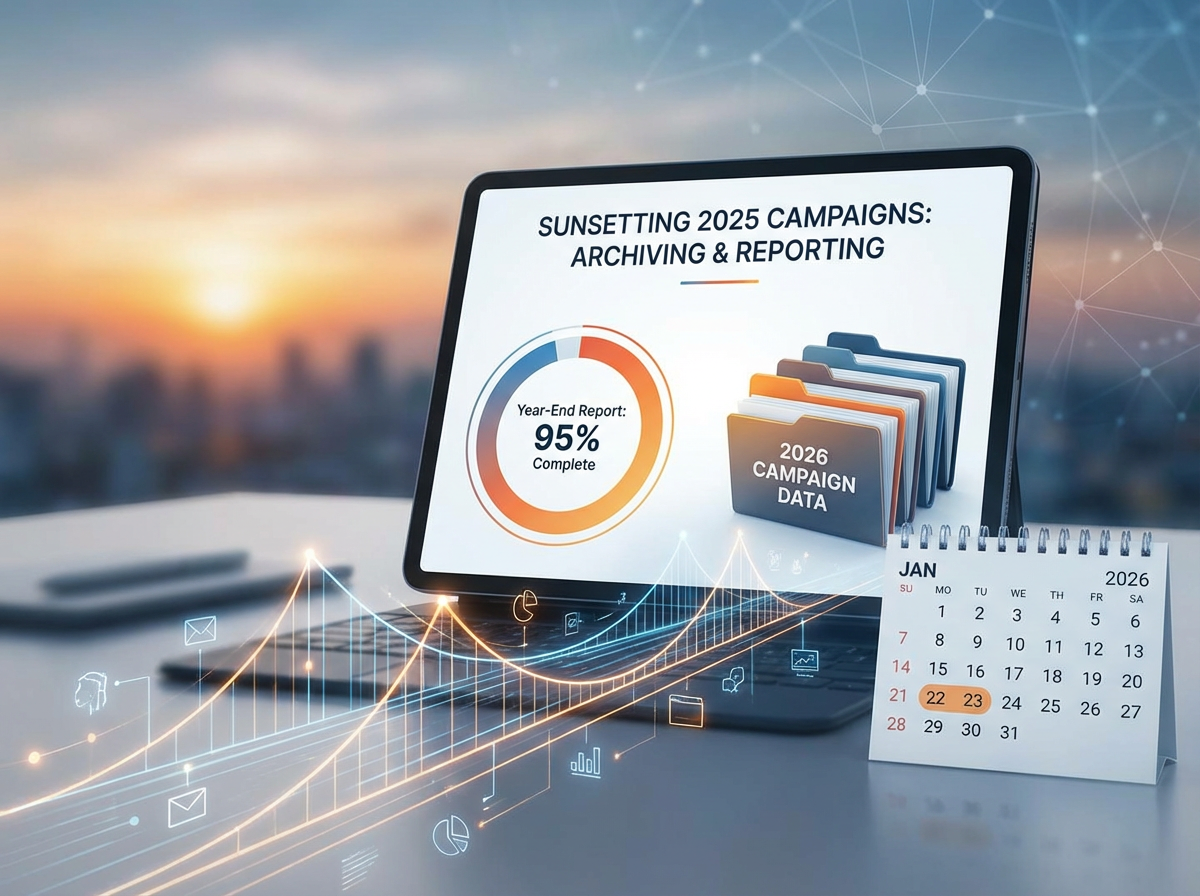
As the final quarter of 2025 draws to a close, the temptation is to pop the champagne, celebrate the wins, and quickly move on to the blank slate of a new year. But looking ahead to 2026, the most successful marketers will be those who treat the end of the year not as a finish line, but as a strategic data-harvesting opportunity. The process of sunsetting 2025 campaigns is no longer a simple administrative task of filing away old creative. In 2026, it's about transforming your historical data into a predictive powerhouse that fuels smarter, more efficient, and hyper-targeted campaigns for the year to come. This guide will walk you through the evolving best practices for archiving and reporting, ensuring your 2025 efforts become the foundation for a dominant 2026.
Key Takeaways for 2026
- Strategic Data Vaults: Moving beyond simple "data dumps," the 2026 approach treats archived campaign data as an active, queryable asset for AI and machine learning models.
- AI-Powered Insight Generation: We expect a surge in tools that automate the analysis of past campaigns, identifying winning creative, audience segments, and messaging patterns from 2025 to apply in 2026.
- Predictive Reporting is the New Standard: Final reports for 2025 campaigns should focus less on what happened and more on what the data predicts for 2026 performance.
- Privacy-Centric Archiving: With evolving data privacy regulations, ensuring your archiving process is compliant and respects user consent will be non-negotiable in 2026.
Table of Contents
- Why a 2026-Forward Approach to Archiving Matters
- The Strategic Archiving Framework for 2026
- Evolving Reporting: From 2025 Rear-View to 2026 Windshield
- Preparing Your Tech Stack for 2026 Archiving
- Frequently Asked Questions
Why a 2026-Forward Approach to Archiving Matters
For years, "archiving" meant moving old campaign folders to a deep, dark corner of a server, never to be seen again. This "file and forget" mentality is a costly mistake in the modern marketing landscape. The data from your 2025 campaigns—every click, conversion, and engagement—is a treasure trove of insights. Looking ahead to 2026, this historical data is the fuel for sophisticated marketing engines.
In 2026, we expect AI and machine learning to be even more integrated into our daily workflows. These systems thrive on historical data to build accurate predictive models, identify subtle trends, and automate audience segmentation. A well-organized archive from 2025 allows you to:
- Train Predictive Models: Use 2025 conversion data to forecast 2026 results and allocate budgets more effectively.
- Identify Creative Fatigue: Analyze asset performance over time to predict when a certain style of creative will lose its impact in 2026.
- Refine Audience Personas: Understand the long-term behavior of your most valuable customer segments from 2025 to better target them in the coming year.
Essentially, a strategic approach to Sunsetting 2025 Campaigns: A Guide to Archiving and Reporting is your first and most critical step in planning for 2026.
The Strategic Archiving Framework for 2026
To build an archive that works for you, you need a system. The 2026 framework moves beyond simple folder structures to a more dynamic, database-like approach.
Step 1: Data Triage and Contextual Tagging
Not all data is created equal. Before you archive, categorize your assets and metrics. For 2026, we predict a move towards "contextual tagging." Every asset, report, and data point should be tagged with key information:
- Campaign Objective: (e.g., Brand Awareness, Lead Gen, Sales)
- Target Audience: (e.g., New-Mothers-25-35, Tech-SMBs)
- Key Offer: (e.g., 20-Percent-Off, Free-Trial)
- Performance Tier: (e.g., Top-10%, Average, Underperformer)
- Creative Elements: (e.g., Video, UGC, Static-Image, Influencer-Collab)
This structured data is invaluable for future analysis. It allows you to quickly ask, "Show me all top-performing video assets from Q4 2025 that targeted SMBs" when planning your Q4 2026 campaigns.
Step 2: Consolidate Your Performance Data
Your campaign data likely lives in multiple platforms: Google Analytics, your ad platforms, your CRM, and your email service provider. The 2026 trend is toward data consolidation. Before archiving, pull the final, verified performance data into a central dashboard or spreadsheet. This creates a single source of truth, preventing confusion down the line. This is also a perfect time to leverage AI-Driven Predictive Segmentation by analyzing which 2025 segments delivered the highest value.
Step 3: Archive Creatives and Copy Intelligently
Archive not just the final creative, but also the working files and different variations. For copy, don't just save the final headline; save the A/B test variations and their performance metrics. In 2026, generative AI tools will be able to analyze this data to suggest new, high-potential creative concepts based on your past winners and losers.
Evolving Reporting: From 2025 Rear-View to 2026 Windshield
The final campaign report is your bridge from 2025 to 2026. Stakeholders are becoming less interested in a simple recap of what happened. They want to know what it means for the future.
Predictive Analytics Over Historical Recaps
In 2026, your year-end reports should have a dedicated "Forward-Looking Implications" section. Instead of saying, "Our CPC in Q4 2025 was $2.15," frame it for the future: "Our analysis of Q4 2025 data suggests that by reallocating 15% of our budget to Audience X, we can project a 10% reduction in CPA for Q1 2026." This proactive stance demonstrates strategic value and builds confidence.
Integrated Storytelling
Data without a story is just noise. The best 2026 reports will weave a narrative. Combine quantitative metrics (ROAS, Conversion Rate) with qualitative insights (customer comments, survey feedback, social media sentiment). This holistic view provides the "why" behind the "what," making the data far more actionable. Running effective post-mortem meetings template 2026 can help you gather these qualitative insights from your team.
Preparing Your Tech Stack for 2026 Archiving
Your ability to implement this forward-looking strategy depends heavily on your tools. As you head into 2026, evaluate if your current tech stack is up to the task.
- Cloud Storage: Ensure you have a solution (like Google Drive, Dropbox Business, or a dedicated DAM) that allows for robust metadata tagging and advanced search.
- Business Intelligence (BI) Tools: Platforms like Tableau, Looker, or Power BI are becoming essential for connecting disparate data sources and creating the dynamic, predictive dashboards that 2026 demands.
- AI-Powered Analytics: Look for tools that have AI features built-in to help you surface insights automatically, rather than requiring manual data-crunching.
Now is the perfect time to conduct a full review. Is your marketing tech stack 2026 ready for these challenges?
Frequently Asked Questions
What's the biggest mistake marketers make when sunsetting campaigns?
The biggest mistake, based on 2025 observations, is the "data dump." Simply moving files into a folder without standardized naming, contextual tags, or a summary of performance makes the data almost useless for future strategic work. In 2026, unstructured archives are a liability.
How long should we keep old campaign data?
While regulatory requirements vary, for marketing strategic purposes, a 3-5 year lookback window is ideal. This provides enough data for meaningful trend analysis and AI model training without hoarding irrelevant information.
What is one key metric from 2025 to carry into 2026 planning?
Look beyond simple conversion rates. In 2026, the focus will be on Customer Lifetime Value (CLV) by acquisition campaign. Knowing which 2025 campaigns brought in the most valuable long-term customers is a game-changer for 2026 budget allocation.
How can a small team implement this advanced archiving process?
Start small. You don't need an enterprise-level DAM on day one. Begin by creating a standardized naming convention and a simple tagging system in a shared spreadsheet. The discipline of organizing is more important than the specific tool you use.
How do we ensure our archiving process is privacy-compliant for 2026?
Focus on anonymizing any Personally Identifiable Information (PII) before long-term archiving. Your reports should focus on aggregate trends and segmented, non-personal data. Stay updated on regulations like GDPR and CCPA, as we expect further evolution in 2026.
Your 2026 Blueprint Starts Now
Ready to build your 2026 marketing powerhouse? Don't let your valuable 2025 data gather digital dust. Start by auditing your current archiving process and exploring how AI can transform your reporting from a history lesson into a strategic forecast. The right preparation today is what separates good from great in the year to come.
Ensure your budget is ready for the tools and strategies that will define next year. Check out our complete guide on budgeting for digital marketing in 2026 to allocate resources effectively.
Conclusion: From Closing the Books to Opening the Future
Sunsetting 2025 campaigns is your first strategic move for 2026. By shifting your mindset from passive storage to active intelligence gathering, you transform past performance into a powerful predictive asset. The emerging trends for 2026 all point towards a more data-driven, AI-enhanced, and forward-looking approach. By building a strategic archiving framework and evolving your reporting to focus on future implications, you're not just closing out a successful year—you're laying the groundwork for an even better one.
Sources & References
Gartner Top Marketing Trends & Predictions - Gartner
Digital Marketing Trends & Statistics - Insider Intelligence