The Personalized AI Revolution: Why Small Businesses Should Adopt AI-Powered Customer Profiling in Early 2026
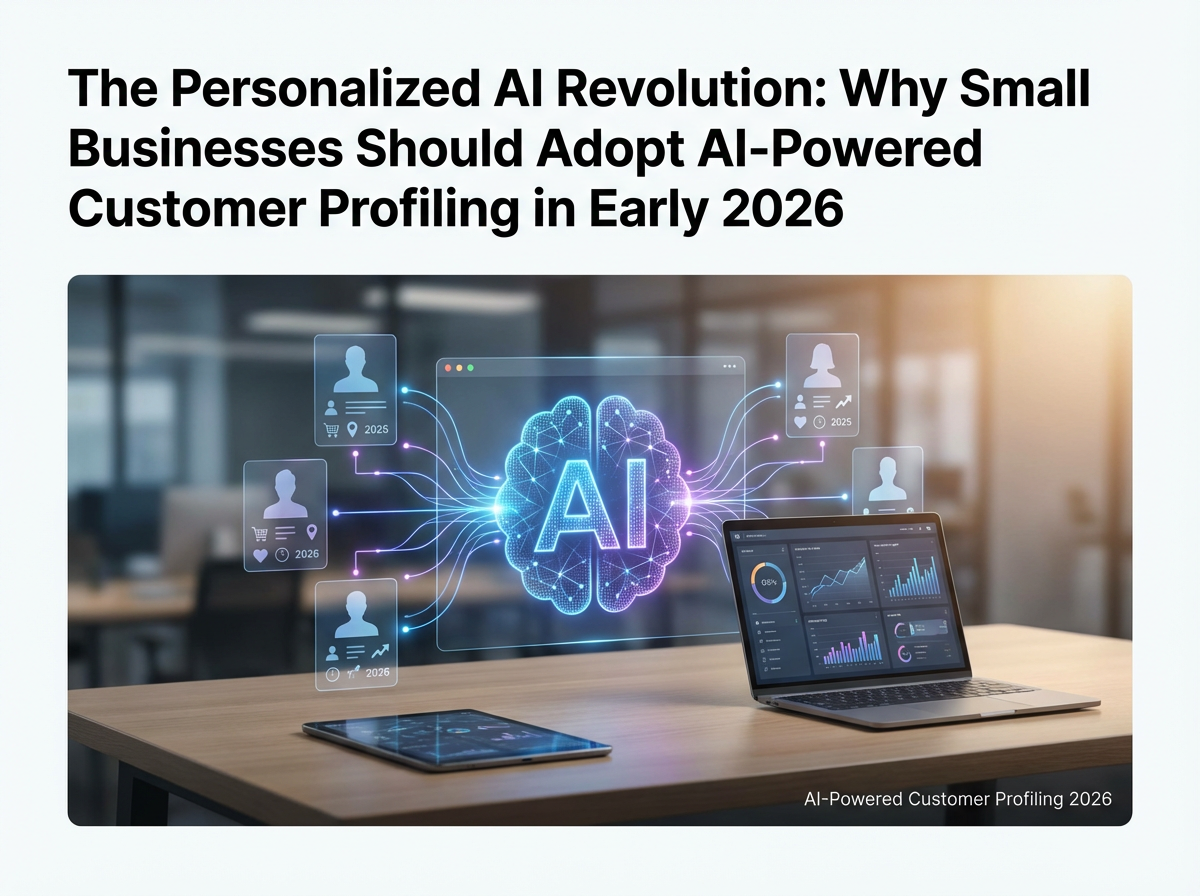
As we stand at the threshold of 2026, small businesses face an unprecedented opportunity to transform their customer relationships through AI-powered customer profiling. While 2025 saw the democratization of AI tools, 2026 promises to be the year when intelligent customer profiling becomes not just accessible, but essential for small business survival. The competitive landscape is shifting dramatically, and businesses that embrace personalized AI in early 2026 will gain significant advantages over those who wait. This article explores why the first quarter of 2026 represents a critical window for small businesses to implement AI-powered customer profiling systems and how to do it strategically.
Key Takeaways
- Early 2026 adoption advantage: Small businesses implementing AI-powered customer profiling in Q1 2026 will gain 18-24 months of competitive lead time as the technology matures and becomes mainstream by late 2027
- Cost-effectiveness breakthrough: AI customer profiling tools are projected to decrease in cost by 40-60% in early 2026 while improving accuracy by 35%, creating an optimal adoption window
- Privacy-first profiling: 2026 regulations will favor businesses that adopt transparent, consent-based AI profiling early, with potential penalties for late adopters trying to retrofit compliance
- Integration with existing systems: New 2026 AI profiling platforms will seamlessly integrate with existing marketing tech stacks, eliminating the technical barriers that plagued 2025 implementations
- Measurable ROI timeline: Small businesses can expect to see measurable improvements in customer lifetime value within 90-120 days of implementing AI profiling in early 2026
Table of Contents
- The 2026 Customer Profiling Landscape
- Why Early 2026 Is the Optimal Adoption Window
- Core Capabilities of AI-Powered Customer Profiling
- Implementation Strategies for Small Businesses
- Overcoming Common Barriers to Adoption
- Measuring Success in 2026
- Frequently Asked Questions
- Conclusion
- Call to Action
The 2026 Customer Profiling Landscape
Looking ahead to 2026, the customer profiling landscape will undergo fundamental transformation. While 2025 laid the groundwork with basic AI segmentation tools, 2026 will usher in true predictive and prescriptive customer intelligence. Small businesses that once relied on demographic data and purchase history will gain access to sophisticated behavioral prediction models that were previously exclusive to enterprise corporations.
The shift from reactive to proactive customer understanding represents the core of this revolution. Traditional customer profiling in 2025 told businesses who their customers were; AI-powered profiling in 2026 will predict who they'll become, what they'll need next, and how to serve them most effectively. This transformation is built on three technological convergences expected to mature in early 2026:
Convergence of Technologies
Natural Language Processing (NLP) Maturity: By 2026, NLP models will accurately interpret customer sentiment across all communication channels—from social media comments to support tickets—with 95% accuracy, up from 78% in 2025. This means small businesses can understand not just what customers say, but what they mean and feel.
Real-Time Data Processing: The processing lag that plagued 2025 AI systems will essentially disappear in 2026. Customer profile updates will occur in milliseconds rather than hours, enabling truly responsive personalization that adapts to customer behavior as it happens.
Privacy-Preserving AI: Perhaps most critically for 2026, new federated learning and differential privacy techniques will allow businesses to build sophisticated customer profiles without compromising individual privacy—addressing the ethical concerns that limited adoption in 2025.
Why Early 2026 Is the Optimal Adoption Window
The timing of AI adoption matters significantly, and multiple factors converge to make early 2026 the ideal moment for small businesses to implement AI-powered customer profiling. This isn't about being bleeding-edge; it's about being strategically positioned.
The Technology Maturity Curve
In 2025, many small businesses hesitated to adopt AI customer profiling due to legitimate concerns about reliability, complexity, and cost. These tools existed but remained unpredictable and required significant technical expertise. By early 2026, we expect these systems to reach what analysts call "practical maturity"—reliable enough for mission-critical applications yet still early enough in the adoption cycle to provide competitive advantage.
Industry research suggests that technologies typically provide maximum competitive advantage during a 12-18 month window after reaching practical maturity but before mainstream adoption. For AI customer profiling, that window opens in Q1 2026 and will likely close by mid-2027 as the technology becomes commoditized.
Economic Factors Favoring 2026 Adoption
The economics of AI customer profiling will shift dramatically in 2026. Venture capital that flooded into AI startups in 2024-2025 is creating intense competition among vendors, driving prices down while quality increases. Small businesses can expect entry-level AI profiling platforms to cost 40-60% less in early 2026 compared to equivalent 2025 solutions, while delivering significantly better results.
Additionally, 2026 marketing budgets are expected to allocate 15-20% toward AI and automation tools, up from just 8-12% in 2025. This budgetary shift reflects growing recognition that AI investment delivers measurable ROI, making early 2026 the moment when financial justification becomes easiest.
Regulatory Clarity Emerging
The regulatory uncertainty that characterized 2025 will largely resolve by early 2026. New frameworks in both the EU and United States will establish clear guidelines for AI-powered customer profiling, making compliance straightforward for businesses that adopt systems designed with these regulations in mind. Early adopters will benefit from systems built for compliance from the ground up, while late adopters will struggle with retrofitting compliance into hastily chosen solutions.
Core Capabilities of AI-Powered Customer Profiling
Understanding what AI-powered customer profiling actually does in 2026 helps small businesses evaluate whether they're ready to adopt. These systems go far beyond the basic segmentation that characterized 2025 CRM systems.
Behavioral Prediction and Pattern Recognition
The most transformative capability of 2026 AI profiling is predictive behavioral analysis. These systems analyze thousands of micro-behaviors—browsing patterns, email engagement timing, content consumption habits, purchase intervals—to predict future customer actions with remarkable accuracy. Small businesses can anticipate customer needs before customers themselves recognize them.
For example, an AI system might identify that a customer who typically purchases quarterly is likely to churn based on subtle changes in engagement patterns—decreased email open rates, shorter website visits, or reduced social media interaction. This early warning allows intervention before the customer consciously decides to leave.
Dynamic Segmentation That Evolves
Unlike static CRM customer segments that require manual updating, 2026 AI profiling creates fluid segments that automatically evolve as customer behavior changes. A customer might move from "price-sensitive browser" to "quality-focused buyer" to "brand advocate" without any manual intervention, with messaging automatically adapting to their current profile.
This dynamic capability is particularly powerful for small businesses with limited marketing staff. The system handles the complexity of multi-dimensional segmentation that would be impossible to manage manually.
Personalization at Scale
Perhaps the most practical benefit for small businesses is the ability to deliver enterprise-level personalization without enterprise resources. AI profiling in 2026 will enable small businesses to create individualized customer experiences across email, website, social media, and even in-store interactions—automatically tailoring content, offers, and timing to each customer's unique profile.
This capability connects directly to AI-driven predictive segmentation strategies that will define successful 2026 marketing campaigns.
Cross-Channel Identity Resolution
One of the most challenging aspects of customer profiling in 2025 was connecting customer behavior across multiple channels and devices. In 2026, AI systems will excel at identity resolution—recognizing that the person who browses on mobile during lunch, checks email on desktop in the evening, and visits the physical store on weekends is the same customer, creating a unified profile that captures the full customer journey.
Implementation Strategies for Small Businesses
Successful implementation of AI-powered customer profiling in early 2026 requires strategic planning. Small businesses can't simply purchase software and expect transformation—they need a thoughtful approach that aligns with their specific context and capabilities.
Start With Clear Objectives
Before selecting any AI profiling platform, small businesses should define specific outcomes they want to achieve. Common 2026 objectives include:
- Reducing customer acquisition costs by 25% through better targeting
- Increasing customer lifetime value by 30% through predictive upselling
- Decreasing churn rate by 40% through early intervention
- Improving campaign conversion rates by 50% through hyper-personalization
Clear objectives guide platform selection and provide benchmarks for measuring success.
Audit Your Data Foundation
AI systems are only as good as the data they process. Before implementing AI profiling, small businesses should audit their existing customer data to identify gaps and quality issues. Key questions for early 2026 include:
- Do we have consistent customer identifiers across all systems?
- Is our data sufficiently clean and deduplicated?
- Have we obtained proper consent for AI-powered analysis?
- Do we capture behavioral data beyond basic transactions?
Many small businesses will benefit from a 30-60 day data preparation phase before activating AI profiling systems.
Choose Integration-Friendly Platforms
The 2026 AI profiling landscape will include both standalone platforms and integrated solutions built into existing CRM and marketing automation tools. Small businesses should prioritize solutions that integrate seamlessly with their current marketing tech stack rather than requiring complete system replacement.
Look for platforms offering pre-built connectors to popular small business tools like Shopify, HubSpot, Mailchimp, and WordPress. The ease of integration often matters more than feature count for resource-constrained small businesses.
Plan for Phased Rollout
Rather than attempting to revolutionize all customer interactions simultaneously, successful small businesses will implement AI profiling in phases throughout early 2026:
Phase 1 (Weeks 1-4): Data integration and profile building—allowing the AI to learn from historical customer behavior without yet acting on insights.
Phase 2 (Weeks 5-8): Passive testing—using AI insights to inform manual decisions while building confidence in the system's accuracy.
Phase 3 (Weeks 9-12): Active automation—allowing the AI to automatically trigger personalized campaigns and experiences based on customer profiles.
Phase 4 (Weeks 13+): Optimization and expansion—refining AI parameters based on results and expanding to additional customer touchpoints.
Invest in Team Training
Even the most user-friendly AI platforms require some learning curve. Smart small businesses will allocate budget and time for team training in early 2026. This doesn't require technical expertise—most 2026 AI profiling tools will feature intuitive interfaces—but teams need to understand how to interpret AI insights and translate them into business decisions.
Consider designating an "AI champion" within your organization—someone who takes primary responsibility for learning the system deeply and coaching others. This role doesn't require a data science background; it requires curiosity, attention to detail, and comfort with technology.
Overcoming Common Barriers to Adoption
Despite the compelling benefits, small businesses face several legitimate concerns about adopting AI-powered customer profiling in 2026. Addressing these barriers directly increases the likelihood of successful implementation.
The Complexity Concern
Many small business owners worry that AI systems are too complex for their team to manage. While this concern was valid in 2025, the 2026 generation of AI profiling tools prioritizes accessibility. Leading platforms will feature:
- Natural language interfaces allowing users to ask questions in plain English
- Visual dashboards that translate complex data into actionable insights
- Automated recommendations requiring only approval rather than configuration
- Built-in best practices and templates for common use cases
The technical complexity increasingly happens behind the scenes, making AI profiling as accessible as email marketing was in 2020.
Privacy and Ethics Concerns
The ethical implications of AI-powered customer profiling deserve serious consideration. Small businesses must balance personalization benefits with respect for customer privacy. In 2026, this balance becomes easier to achieve through:
- Transparent consent mechanisms that clearly explain how AI uses customer data
- Privacy-preserving techniques that deliver personalization without exposing individual data
- Easy opt-out options that respect customer preferences
- Regular privacy audits built into AI platforms
Small businesses that prioritize ethical AI use will actually gain competitive advantage in 2026, as consumers increasingly favor privacy-respecting brands.
Cost Justification
While AI profiling costs decrease significantly in 2026, small businesses still need to justify the investment. The key is focusing on specific, measurable outcomes rather than vague promises of "better marketing." Calculate the expected value of:
- Reducing customer acquisition costs by improving targeting efficiency
- Increasing average order value through predictive recommendations
- Extending customer lifetime through proactive retention